

Updated November 25, 2024

Inflation Exposed: Understanding How Inflation Impacts Your Portfolio and What to Do About It

Inflation Exposed: Understanding How Inflation Impacts Your Portfolio and What to Do About It

Inflation Exposed: Understanding How Inflation Impacts Your Portfolio and What to Do About It

AJ Giannone, CFA
AJ Giannone, CFA
AJ Giannone, CFA

Allio Capital Team

The Macroscope

Inflation is one of those buzzwords that’s been dominating financial headlines for the past few years, and it’s more than just a news story—it's something that affects your purchasing power, your lifestyle, and your investments. But inflation isn’t one-dimensional. To understand how it truly impacts your portfolio, it's critical to understand three key forms of inflation: realized inflation, inflation expectations, and breakeven inflation.

Let's drill down and look at how different types of assets react to each, as well as how you can position your portfolio to be resilient in the face of some different types of inflation shocks.

Realized Inflation: What It Is and How It Affects You

Realized inflation is what has already happened. It’s the kind of inflation you’ve noticed at the gas pump or grocery store. The government reports this figure through data like the Consumer Price Index (CPI). When realized inflation is high, your dollars buy less than they used to.

Different assets react differently to realized inflation. For example:

  • Commodities (like oil and gold) tend to perform well in periods of high realized inflation. Gold is often seen as a hedge against inflation because its value isn't tied directly to any currency.

  • Fixed income investments (such as bonds) usually struggle. When inflation erodes the purchasing power of future cash flows, bond prices can drop, especially if interest rates rise in response.

  • Equities can be a mixed bag—companies with strong pricing power (like consumer staples or utilities) tend to perform better, as they can pass higher costs on to consumers.

Figure 1 - Consumer Price Index (Year over year percentage change)

Inflation Expectations: The Market's View of the Future

Inflation expectations are what the market or economic participants anticipate inflation will be in the future. This is more abstract but just as crucial, especially for long-term investors.

Market expectations of inflation can heavily influence asset pricing. If investors expect inflation to rise, they may demand higher yields for long-term bonds, pushing down bond prices. This is particularly impactful for long-duration assets, such as technology or growth stocks, which derive a significant portion of their value from cash flows expected far into the future. In a discounted cash flow (DCF) valuation framework, higher inflation expectations increase discount rates, which lowers the present value of these future cash flows, thereby reducing the value of long-duration assets like long term bonds and growth stocks. Notably, inflation expectations can influence asset prices even in the absence of changes in realized inflation, as market sentiment and future projections shift valuations independently of current inflation data.

Figure 2 - 2 and 5 Year Expected Inflation (Year over year percentage change)

Breakeven Inflation: The Middle Ground

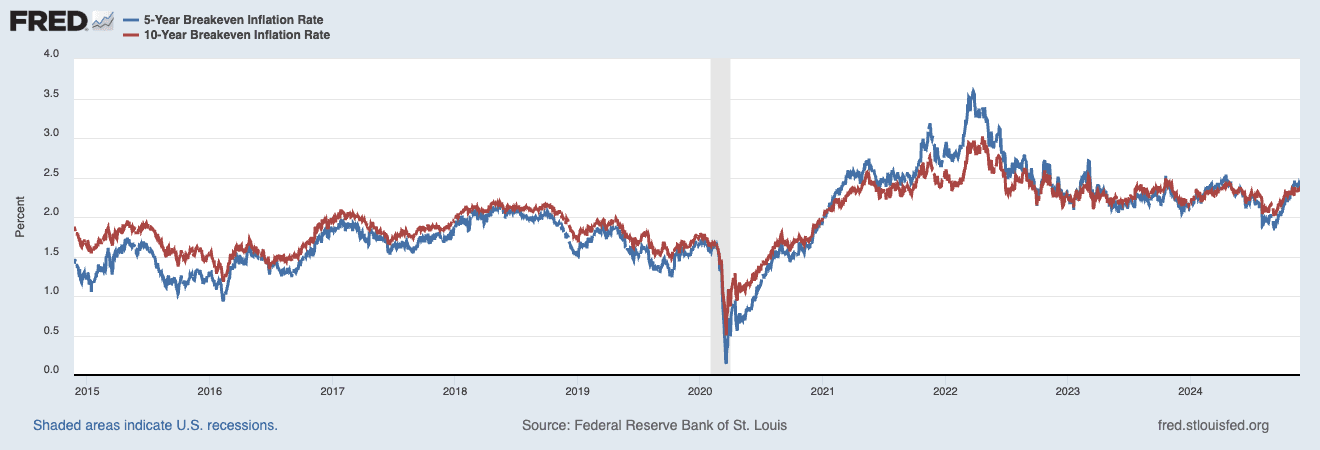
Breakeven inflation is the difference between the yield on a nominal Treasury bond and an inflation-protected Treasury (TIPS) of the same maturity. It provides insight into what the market expects in terms of inflation over a given period. TIPS perform differently based on realized inflation versus changes in inflation expectations. When realized inflation increases, TIPS adjust their payouts accordingly, providing a hedge against the actual loss of purchasing power. However, changes in inflation expectations can also influence TIPS performance indirectly, as rising expectations can increase the demand for TIPS even before inflation materializes, leading to an increase in their market price. Thus, TIPS can react positively to both rising realized inflation and growing inflation expectations, though the mechanisms differ in terms of magnitude and timing.

If breakeven inflation is rising, it can indicate that investors see a greater chance of inflationary pressures in the future. TIPS tend to perform well under such conditions, as they adjust their payouts based on realized inflation, offering a direct hedge. However, a key risk in an inflationary scenario is that interest rates often rise, which can reduce the prices of TIPS bonds, all else equal. This means that in practice, TIPS often perform relatively better as a hedge against increasing inflation expectations rather than against sudden shocks to realized inflation.

Figure 3 - 5 & 10 Year Breakeven Inflation Rate (Year over year percentage change)
Positioning Your Portfolio to Withstand Inflation

Inflation, no matter its form, poses challenges, but also opportunities for your portfolio. Here are some practical steps to consider to make your portfolio resilient:

1. Diversify with Inflation-Resilient Assets: Consider assets like commodities, real estate, and Treasury Inflation-Protected Securities (TIPS). These investments tend to fare better when inflation accelerates.

2. Focus on Equities with Pricing Power: Look for companies in sectors that can pass rising costs onto consumers. Consumer staples, healthcare, and utilities are often well-positioned here.

3. Consider Shorter-Duration Bonds: Longer-term bonds tend to suffer the most when inflation rises, as they lock in lower interest rates. Shorter-duration bonds or floating rate bonds can help protect your income from inflation shocks.

The 30,000 ft view

Understanding realized inflation, inflation expectations, and breakeven inflation can help you build a portfolio that’s ready to adapt, no matter what happens next. Inflation is a constant factor in the financial landscape, but by diversifying across asset classes that respond differently to inflation pressures, you can position yourself to manage risk and seize opportunities.

If you’re looking to put these lessons into practice, check out Allio Capital. We help investors navigate complex macroeconomic landscapes with insights and strategies designed to bolster your portfolio in all environments.


Inflation is one of those buzzwords that’s been dominating financial headlines for the past few years, and it’s more than just a news story—it's something that affects your purchasing power, your lifestyle, and your investments. But inflation isn’t one-dimensional. To understand how it truly impacts your portfolio, it's critical to understand three key forms of inflation: realized inflation, inflation expectations, and breakeven inflation.

Let's drill down and look at how different types of assets react to each, as well as how you can position your portfolio to be resilient in the face of some different types of inflation shocks.

Realized Inflation: What It Is and How It Affects You

Realized inflation is what has already happened. It’s the kind of inflation you’ve noticed at the gas pump or grocery store. The government reports this figure through data like the Consumer Price Index (CPI). When realized inflation is high, your dollars buy less than they used to.

Different assets react differently to realized inflation. For example:

  • Commodities (like oil and gold) tend to perform well in periods of high realized inflation. Gold is often seen as a hedge against inflation because its value isn't tied directly to any currency.

  • Fixed income investments (such as bonds) usually struggle. When inflation erodes the purchasing power of future cash flows, bond prices can drop, especially if interest rates rise in response.

  • Equities can be a mixed bag—companies with strong pricing power (like consumer staples or utilities) tend to perform better, as they can pass higher costs on to consumers.

Figure 1 - Consumer Price Index (Year over year percentage change)

Inflation Expectations: The Market's View of the Future

Inflation expectations are what the market or economic participants anticipate inflation will be in the future. This is more abstract but just as crucial, especially for long-term investors.

Market expectations of inflation can heavily influence asset pricing. If investors expect inflation to rise, they may demand higher yields for long-term bonds, pushing down bond prices. This is particularly impactful for long-duration assets, such as technology or growth stocks, which derive a significant portion of their value from cash flows expected far into the future. In a discounted cash flow (DCF) valuation framework, higher inflation expectations increase discount rates, which lowers the present value of these future cash flows, thereby reducing the value of long-duration assets like long term bonds and growth stocks. Notably, inflation expectations can influence asset prices even in the absence of changes in realized inflation, as market sentiment and future projections shift valuations independently of current inflation data.

Figure 2 - 2 and 5 Year Expected Inflation (Year over year percentage change)

Breakeven Inflation: The Middle Ground

Breakeven inflation is the difference between the yield on a nominal Treasury bond and an inflation-protected Treasury (TIPS) of the same maturity. It provides insight into what the market expects in terms of inflation over a given period. TIPS perform differently based on realized inflation versus changes in inflation expectations. When realized inflation increases, TIPS adjust their payouts accordingly, providing a hedge against the actual loss of purchasing power. However, changes in inflation expectations can also influence TIPS performance indirectly, as rising expectations can increase the demand for TIPS even before inflation materializes, leading to an increase in their market price. Thus, TIPS can react positively to both rising realized inflation and growing inflation expectations, though the mechanisms differ in terms of magnitude and timing.

If breakeven inflation is rising, it can indicate that investors see a greater chance of inflationary pressures in the future. TIPS tend to perform well under such conditions, as they adjust their payouts based on realized inflation, offering a direct hedge. However, a key risk in an inflationary scenario is that interest rates often rise, which can reduce the prices of TIPS bonds, all else equal. This means that in practice, TIPS often perform relatively better as a hedge against increasing inflation expectations rather than against sudden shocks to realized inflation.

Figure 3 - 5 & 10 Year Breakeven Inflation Rate (Year over year percentage change)

Positioning Your Portfolio to Withstand Inflation

Inflation, no matter its form, poses challenges, but also opportunities for your portfolio. Here are some practical steps to consider to make your portfolio resilient:

1. Diversify with Inflation-Resilient Assets: Consider assets like commodities, real estate, and Treasury Inflation-Protected Securities (TIPS). These investments tend to fare better when inflation accelerates.

2. Focus on Equities with Pricing Power: Look for companies in sectors that can pass rising costs onto consumers. Consumer staples, healthcare, and utilities are often well-positioned here.

3. Consider Shorter-Duration Bonds: Longer-term bonds tend to suffer the most when inflation rises, as they lock in lower interest rates. Shorter-duration bonds or floating rate bonds can help protect your income from inflation shocks.

The 30,000 ft view

Understanding realized inflation, inflation expectations, and breakeven inflation can help you build a portfolio that’s ready to adapt, no matter what happens next. Inflation is a constant factor in the financial landscape, but by diversifying across asset classes that respond differently to inflation pressures, you can position yourself to manage risk and seize opportunities.

If you’re looking to put these lessons into practice, check out Allio Capital. We help investors navigate complex macroeconomic landscapes with insights and strategies designed to bolster your portfolio in all environments.

Inflation is one of those buzzwords that’s been dominating financial headlines for the past few years, and it’s more than just a news story—it's something that affects your purchasing power, your lifestyle, and your investments. But inflation isn’t one-dimensional. To understand how it truly impacts your portfolio, it's critical to understand three key forms of inflation: realized inflation, inflation expectations, and breakeven inflation.

Let's drill down and look at how different types of assets react to each, as well as how you can position your portfolio to be resilient in the face of some different types of inflation shocks.

Realized Inflation: What It Is and How It Affects You

Realized inflation is what has already happened. It’s the kind of inflation you’ve noticed at the gas pump or grocery store. The government reports this figure through data like the Consumer Price Index (CPI). When realized inflation is high, your dollars buy less than they used to.

Different assets react differently to realized inflation. For example:

  • Commodities (like oil and gold) tend to perform well in periods of high realized inflation. Gold is often seen as a hedge against inflation because its value isn't tied directly to any currency.

  • Fixed income investments (such as bonds) usually struggle. When inflation erodes the purchasing power of future cash flows, bond prices can drop, especially if interest rates rise in response.

  • Equities can be a mixed bag—companies with strong pricing power (like consumer staples or utilities) tend to perform better, as they can pass higher costs on to consumers.

Figure 1 - Consumer Price Index (Year over year percentage change)

Inflation Expectations: The Market's View of the Future

Inflation expectations are what the market or economic participants anticipate inflation will be in the future. This is more abstract but just as crucial, especially for long-term investors.

Market expectations of inflation can heavily influence asset pricing. If investors expect inflation to rise, they may demand higher yields for long-term bonds, pushing down bond prices. This is particularly impactful for long-duration assets, such as technology or growth stocks, which derive a significant portion of their value from cash flows expected far into the future. In a discounted cash flow (DCF) valuation framework, higher inflation expectations increase discount rates, which lowers the present value of these future cash flows, thereby reducing the value of long-duration assets like long term bonds and growth stocks. Notably, inflation expectations can influence asset prices even in the absence of changes in realized inflation, as market sentiment and future projections shift valuations independently of current inflation data.

Figure 2 - 2 and 5 Year Expected Inflation (Year over year percentage change)

Breakeven Inflation: The Middle Ground

Breakeven inflation is the difference between the yield on a nominal Treasury bond and an inflation-protected Treasury (TIPS) of the same maturity. It provides insight into what the market expects in terms of inflation over a given period. TIPS perform differently based on realized inflation versus changes in inflation expectations. When realized inflation increases, TIPS adjust their payouts accordingly, providing a hedge against the actual loss of purchasing power. However, changes in inflation expectations can also influence TIPS performance indirectly, as rising expectations can increase the demand for TIPS even before inflation materializes, leading to an increase in their market price. Thus, TIPS can react positively to both rising realized inflation and growing inflation expectations, though the mechanisms differ in terms of magnitude and timing.

If breakeven inflation is rising, it can indicate that investors see a greater chance of inflationary pressures in the future. TIPS tend to perform well under such conditions, as they adjust their payouts based on realized inflation, offering a direct hedge. However, a key risk in an inflationary scenario is that interest rates often rise, which can reduce the prices of TIPS bonds, all else equal. This means that in practice, TIPS often perform relatively better as a hedge against increasing inflation expectations rather than against sudden shocks to realized inflation.

Figure 3 - 5 & 10 Year Breakeven Inflation Rate (Year over year percentage change)

Positioning Your Portfolio to Withstand Inflation

Inflation, no matter its form, poses challenges, but also opportunities for your portfolio. Here are some practical steps to consider to make your portfolio resilient:

1. Diversify with Inflation-Resilient Assets: Consider assets like commodities, real estate, and Treasury Inflation-Protected Securities (TIPS). These investments tend to fare better when inflation accelerates.

2. Focus on Equities with Pricing Power: Look for companies in sectors that can pass rising costs onto consumers. Consumer staples, healthcare, and utilities are often well-positioned here.

3. Consider Shorter-Duration Bonds: Longer-term bonds tend to suffer the most when inflation rises, as they lock in lower interest rates. Shorter-duration bonds or floating rate bonds can help protect your income from inflation shocks.

The 30,000 ft view

Understanding realized inflation, inflation expectations, and breakeven inflation can help you build a portfolio that’s ready to adapt, no matter what happens next. Inflation is a constant factor in the financial landscape, but by diversifying across asset classes that respond differently to inflation pressures, you can position yourself to manage risk and seize opportunities.

If you’re looking to put these lessons into practice, check out Allio Capital. We help investors navigate complex macroeconomic landscapes with insights and strategies designed to bolster your portfolio in all environments.

Share
Share
Share

Ready to elevate your macro investing strategy?

Download Now

Ready to elevate your macro investing strategy?

Download Now

Ready to elevate your macro investing strategy?

Download Now

Related Articles

Allio Capital Team

Case Study: How Forward-Thinking Wealth Advisors Reduce Portfolio Management Costs and Improve Client Value with ALTITUDE AI

Wealth advisors are facing mounting pressure to control costs—both for clients and their own practices. Traditional models of outsourced portfolio management, hiring expensive specialists like CFAs or portfolio managers, and relying on legacy systems often result in significant portfolio management costs that erode client returns and advisor margins. According to industry research, 59% of a typical client’s assets-under-management (AUM) fee is allocated to investment management costs, with the rest spent on planning and other advisory work. This allocation underscores how much of what clients pay often goes toward asset management costs rather than value-added planning services. ALTITUDE AI empowers advisors to bring portfolio management in-house, using modern portfolio construction software for advisors to reduce fees, scale personalization, and improve profitability.

Allio Capital Team

Case Study: How Financial Advisors Really Spend Their Time — And Why Generic AI Tools Fall Short

Allio’s ALTITUDE AI is purpose-built to help financial advisors reclaim their time by automating compliance notes, generating market commentary, building customized client portfolios, and responding intelligently to client questions — all within a compliance-ready framework designed for wealth management.

Allio Capital Team

The Future of Wealth Advisement: How AI and Macro Insights Are Redefining Modern Portfolio Management

Discover how AI wealth management, macro-based advisement, and next-gen digital wealth advisors are transforming investment strategy, portfolio management, and retirement planning.

Disclosures

This material is for informational purposes only and should not be construed as financial, legal, or tax advice. You should consult your own financial, legal, and tax advisors before engaging in any transaction. Information, including hypothetical projections of finances, may not take into account taxes, commissions, or other factors which may significantly affect potential outcomes. This material should not be considered an offer or recommendation to buy or sell a security. While information and sources are believed to be accurate, Allio Advisors does not guarantee the accuracy or completeness of any information or source provided herein and is under no obligation to update this information. 

Past performance is not a guarantee or a reliable indicator of future results. All investments contain risk and may lose value. Performance could be volatile; an investment in a fund or an account may lose money.

There is no guarantee that these investment strategies will work under all market conditions or are appropriate for all investors and each investor should evaluate their ability to invest long-term, especially during periods of downturn in the market.

This advertisement is provided by Allio Advisors for informational purposes only and should not be considered investment advice, a recommendation, or a solicitation to buy or sell any securities. Investment decisions should be based on your specific financial situation and objectives, considering the risks and uncertainties associated with investing.

The views and forecasts expressed are those of Allio Advisors and are subject to change without notice. Past performance is not indicative of future results, and investing involves risk, including the possible loss of principal. Market volatility, economic conditions, and changes in government policy may impact the accuracy of these forecasts and the performance of any investment.

Allio Advisors utilizes proprietary technologies and methodologies, but no investment strategy can guarantee returns or eliminate risk. Investors should carefully consider their investment goals, risk tolerance, and financial circumstances before investing.

For more detailed information about our strategies and associated risks, please refer to the full disclosures available on our website or contact the Allio Advisors support team.

For informational purposes only; not personalized investment advice. All investments involve risk of loss. Past performance of any index or strategy is not indicative of future results. Any projections or forward-looking statements are hypothetical and not guaranteed. Allio Advisors is an SEC-registered investment adviser – see our Form ADV for details. No content should be construed as a recommendation to buy or sell any security.

Disclosures

This material is for informational purposes only and should not be construed as financial, legal, or tax advice. You should consult your own financial, legal, and tax advisors before engaging in any transaction. Information, including hypothetical projections of finances, may not take into account taxes, commissions, or other factors which may significantly affect potential outcomes. This material should not be considered an offer or recommendation to buy or sell a security. While information and sources are believed to be accurate, Allio Advisors does not guarantee the accuracy or completeness of any information or source provided herein and is under no obligation to update this information. 

Past performance is not a guarantee or a reliable indicator of future results. All investments contain risk and may lose value. Performance could be volatile; an investment in a fund or an account may lose money.

There is no guarantee that these investment strategies will work under all market conditions or are appropriate for all investors and each investor should evaluate their ability to invest long-term, especially during periods of downturn in the market.

This advertisement is provided by Allio Advisors for informational purposes only and should not be considered investment advice, a recommendation, or a solicitation to buy or sell any securities. Investment decisions should be based on your specific financial situation and objectives, considering the risks and uncertainties associated with investing.

The views and forecasts expressed are those of Allio Advisors and are subject to change without notice. Past performance is not indicative of future results, and investing involves risk, including the possible loss of principal. Market volatility, economic conditions, and changes in government policy may impact the accuracy of these forecasts and the performance of any investment.

Allio Advisors utilizes proprietary technologies and methodologies, but no investment strategy can guarantee returns or eliminate risk. Investors should carefully consider their investment goals, risk tolerance, and financial circumstances before investing.

For more detailed information about our strategies and associated risks, please refer to the full disclosures available on our website or contact the Allio Advisors support team.

For informational purposes only; not personalized investment advice. All investments involve risk of loss. Past performance of any index or strategy is not indicative of future results. Any projections or forward-looking statements are hypothetical and not guaranteed. Allio Advisors is an SEC-registered investment adviser – see our Form ADV for details. No content should be construed as a recommendation to buy or sell any security.

Disclosures

This material is for informational purposes only and should not be construed as financial, legal, or tax advice. You should consult your own financial, legal, and tax advisors before engaging in any transaction. Information, including hypothetical projections of finances, may not take into account taxes, commissions, or other factors which may significantly affect potential outcomes. This material should not be considered an offer or recommendation to buy or sell a security. While information and sources are believed to be accurate, Allio Advisors does not guarantee the accuracy or completeness of any information or source provided herein and is under no obligation to update this information. 

Past performance is not a guarantee or a reliable indicator of future results. All investments contain risk and may lose value. Performance could be volatile; an investment in a fund or an account may lose money.

There is no guarantee that these investment strategies will work under all market conditions or are appropriate for all investors and each investor should evaluate their ability to invest long-term, especially during periods of downturn in the market.

This advertisement is provided by Allio Advisors for informational purposes only and should not be considered investment advice, a recommendation, or a solicitation to buy or sell any securities. Investment decisions should be based on your specific financial situation and objectives, considering the risks and uncertainties associated with investing.

The views and forecasts expressed are those of Allio Advisors and are subject to change without notice. Past performance is not indicative of future results, and investing involves risk, including the possible loss of principal. Market volatility, economic conditions, and changes in government policy may impact the accuracy of these forecasts and the performance of any investment.

Allio Advisors utilizes proprietary technologies and methodologies, but no investment strategy can guarantee returns or eliminate risk. Investors should carefully consider their investment goals, risk tolerance, and financial circumstances before investing.

For more detailed information about our strategies and associated risks, please refer to the full disclosures available on our website or contact the Allio Advisors support team.

For informational purposes only; not personalized investment advice. All investments involve risk of loss. Past performance of any index or strategy is not indicative of future results. Any projections or forward-looking statements are hypothetical and not guaranteed. Allio Advisors is an SEC-registered investment adviser – see our Form ADV for details. No content should be construed as a recommendation to buy or sell any security.

By using this website, you accept our Terms of Service and our Privacy Policy. Nothing on this website should be considered an offer, recommendation, solicitation of an offer, or advice to buy or sell any security. The information provided herein is for informational and general educational purposes only and is not investment or financial advice. Additionally, Allio does not provide tax advice and investors are encouraged to consult with their tax advisor. 


v1 01.22.2026

By using this website, you accept our Terms of Service and our Privacy Policy. Nothing on this website should be considered an offer, recommendation, solicitation of an offer, or advice to buy or sell any security. The information provided herein is for informational and general educational purposes only and is not investment or financial advice. Additionally, Allio does not provide tax advice and investors are encouraged to consult with their tax advisor. 


v1 01.22.2026

By using this website, you accept our Terms of Service and our Privacy Policy. Nothing on this website should be considered an offer, recommendation, solicitation of an offer, or advice to buy or sell any security. The information provided herein is for informational and general educational purposes only and is not investment or financial advice. Additionally, Allio does not provide tax advice and investors are encouraged to consult with their tax advisor. 


v1 01.22.2026