

Updated February 11, 2026
Case Study: How Financial Advisors Really Spend Their Time — And Why Generic AI Tools Fall Short


Allio Capital Team
The Macroscope
Allio’s ALTITUDE AI is purpose-built to help financial advisors reclaim their time by automating compliance notes, generating market commentary, building customized client portfolios, and responding intelligently to client questions — all within a compliance-ready framework designed for wealth management.
Despite continuous advances in advisor technology, most financial advisors still spend a surprising amount of time on tasks that have nothing to do with what actually grows an advisory business: hunting for and gathering assets under management (AUM).
This case study examines where advisor time actually goes, why productivity gains have stalled, and why generic AI writing tools like Microsoft Copilot or ChatGPT are insufficient for regulated financial advice workflows.
The Advisor Productivity Problem
The public perception is that financial advisors spend most of their time advising clients and managing portfolios. Data shows something very different.
Industry research reveals:
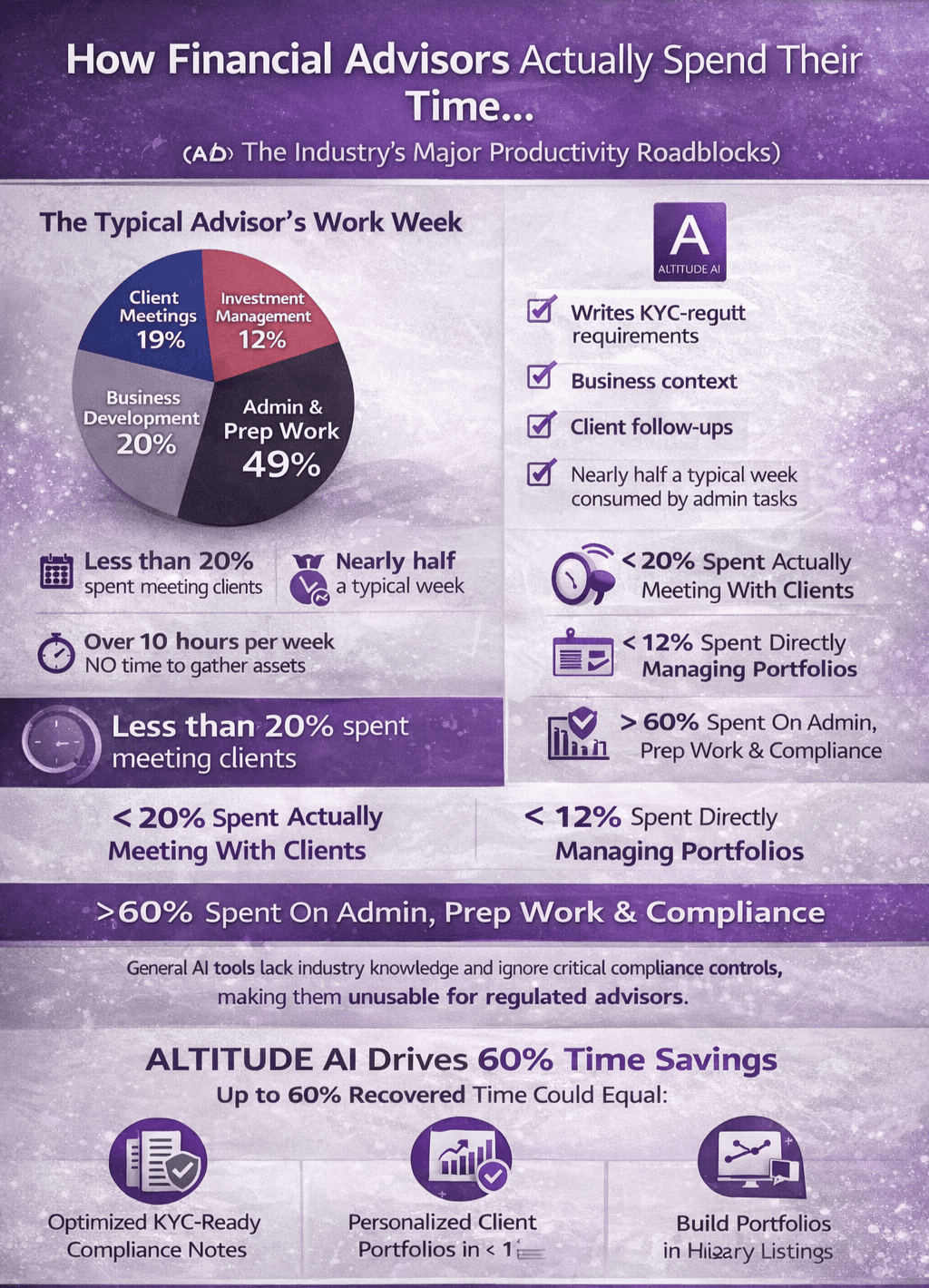
The typical financial advisor spends only about 50% of their time on direct client-related activity.
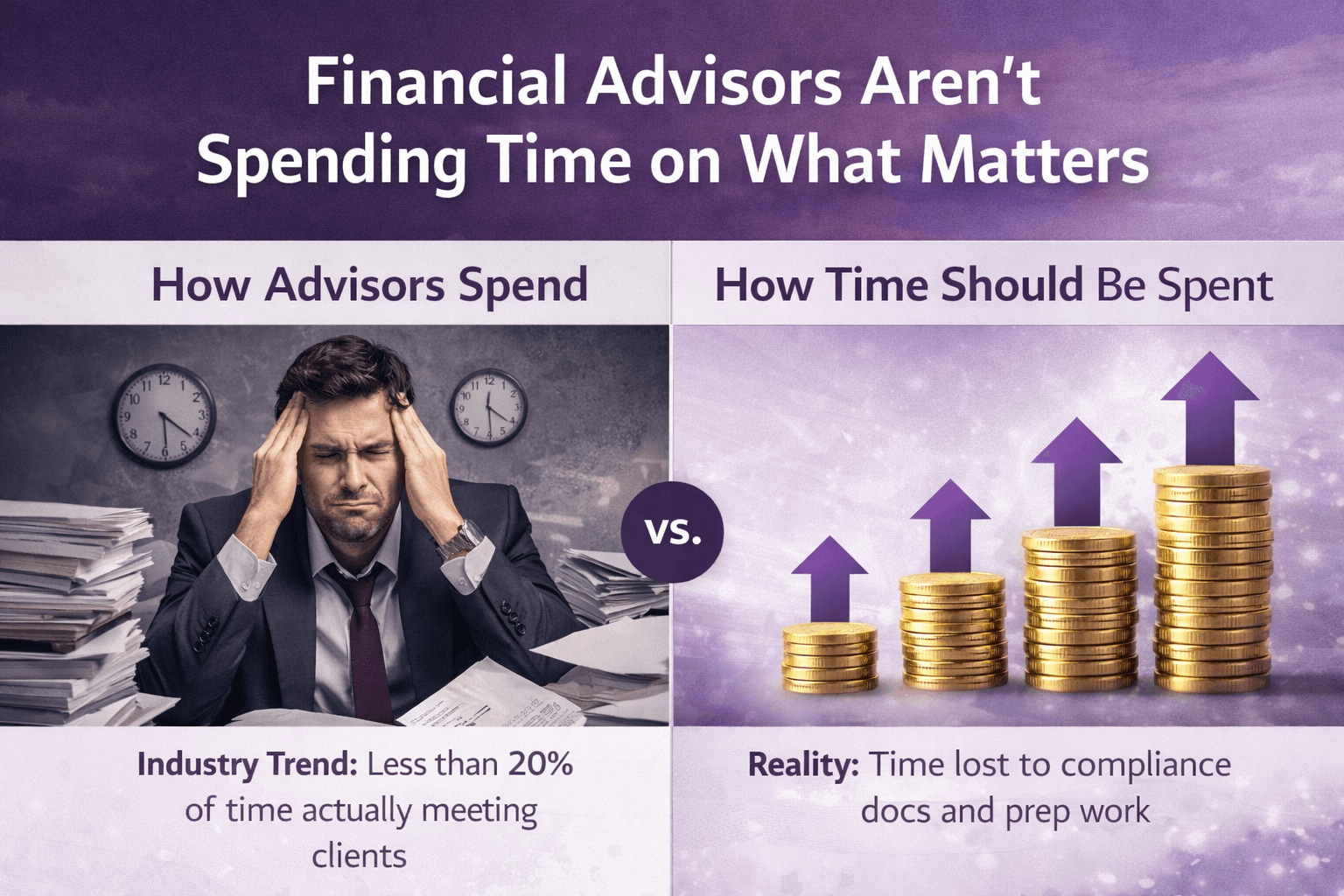
Less than 20% of their time is actually spent meeting with clients.
Advisors spend nearly as much time prospecting and marketing for new clients as they do meeting existing ones.
Untitled document
In practice, advisor time is heavily consumed by:
Meeting preparation
Financial planning analysis
Compliance documentation
Portfolio explanations
Client servicing follow-ups
Administrative work
Investment implementation
Business operations
Ironically, actual investment management consumes only a small fraction of advisor time, even though portfolio management drives most advisory revenue.
https://www.kitces.com/blog/how-do-financial-advisors-spend-time-research-study-productivity-capacity-efficiency/
Advisors Are Drowning in Back-Office Work
For RIAs and independent advisors, growth depends on:
Increasing assets under management
Retaining clients
Delivering high-touch service
Maintaining regulatory compliance
Producing personalized portfolio updates
Documenting every client interaction
But these requirements generate enormous operational overhead.
Major time drains include:
Writing compliance-ready client meeting notes
Producing customized market commentary
Preparing portfolio explanations
Responding to client market questions
Maintaining KYC and suitability records
Building portfolios aligned with client risk tolerance
Documenting investment rationale
Every minute spent here is time not spent gathering assets or strengthening referral pipelines.
Why Conventional AI Tools Don’t Solve the Problem
Many advisors try Microsoft Copilot or ChatGPT to increase productivity. The results are often unusable in regulated advisory environments.
No Understanding of KYC or Suitability
Generic AI tools don’t understand:
Risk tolerance requirements
Client suitability constraints
Investment policy requirements
Fiduciary obligations
Outputs must be rewritten manually.
No Compliance Awareness
Compliance teams require:
Neutral language
Documentation standards
Audit-ready notes
Proper investment rationales
Generic AI frequently produces compliance-risky content.
No Portfolio or Market Intelligence
Conventional AI:
Cannot tie commentary to actual portfolios
Lacks macro market context
Produces generic outputs
Fails personalization requirements
Advisors still must edit heavily.
Real-World Results: Advisors Using ALTITUDE AI See 60% Time Savings
Advisors using ALTITUDE AI report up to 60% reductions in time spent on documentation, portfolio explanation, commentary drafting, and client response workflows.
Let’s translate that into real advisor economics.
Step 1 — Where time is lost today
A typical advisor works about 43 hours per week.
Of that:
~9 hours go to business development.
~8–9 hours are spent in meetings.
Nearly 18 hours are spent on preparation, analysis, and client servicing work surrounding those meetings.
This non-meeting client work is exactly where ALTITUDE AI operates.
Step 2 — Time savings calculation
If ALTITUDE AI reduces this workload by 60%, advisors reclaim:
≈ 10–11 hours per week
That equals:
40+ hours per month
500+ hours per year
Or the equivalent of 12+ extra work weeks annually.
Step 3 — What is that time worth financially?
If advisors redirect just half of those recovered hours toward asset gathering and client acquisition:
Conservative growth example
Assume an advisor gains:
One additional $1M client every 6 weeks using this extra time
Charging a standard 1% advisory fee
That equals:
≈ $80,000–100,000 in additional annual recurring revenue
More productive firms could see multiples of that.
And importantly:
This growth happens without increasing total working hours, only reallocating time away from administrative tasks.
The Real Productivity Constraint: Human Capacity
Technology hasn’t allowed advisors to serve exponentially more clients. Instead, advisors use efficiencies to deliver deeper service to the same number of clients.
Research suggests advisors hit natural relationship limits around 100–150 client relationships regardless of technology improvements.
Untitled document
Which means:
Growth must come from spending more time on relationships and asset gathering — not paperwork.
Case Study Insight: Where Real Efficiency Comes From
The biggest efficiency gains occur when advisors automate:
Compliance note writing
Portfolio explanations
Market commentary generation
Client response drafting
Portfolio construction assistance
Meeting preparation workflows
This is precisely where generic AI tools fall short — and where purpose-built advisor AI succeeds.
Conclusion: Purpose-Built Advisor AI Is Becoming Essential
Financial advisors don’t need generic writing assistants.
They need AI that understands:
Markets
Portfolios
Client suitability
Compliance requirements
Advisory workflows
AUM growth realities
Allio’s ALTITUDE AI was purpose-built to automate compliance notes, generate market commentary, construct client portfolios, and respond intelligently to client questions — freeing advisors to focus on asset gathering, client relationships, and business growth.
Firms already using ALTITUDE AI are seeing material time savings and measurable revenue expansion.
As compliance complexity grows and advisor capacity tightens, purpose-built AI is no longer optional.
It is becoming a competitive advantage.
Allio’s ALTITUDE AI is purpose-built to help financial advisors reclaim their time by automating compliance notes, generating market commentary, building customized client portfolios, and responding intelligently to client questions — all within a compliance-ready framework designed for wealth management.
Despite continuous advances in advisor technology, most financial advisors still spend a surprising amount of time on tasks that have nothing to do with what actually grows an advisory business: hunting for and gathering assets under management (AUM).
This case study examines where advisor time actually goes, why productivity gains have stalled, and why generic AI writing tools like Microsoft Copilot or ChatGPT are insufficient for regulated financial advice workflows.
The Advisor Productivity Problem
The public perception is that financial advisors spend most of their time advising clients and managing portfolios. Data shows something very different.
Industry research reveals:
The typical financial advisor spends only about 50% of their time on direct client-related activity.
Less than 20% of their time is actually spent meeting with clients.
Advisors spend nearly as much time prospecting and marketing for new clients as they do meeting existing ones.
Untitled document
In practice, advisor time is heavily consumed by:
Meeting preparation
Financial planning analysis
Compliance documentation
Portfolio explanations
Client servicing follow-ups
Administrative work
Investment implementation
Business operations
Ironically, actual investment management consumes only a small fraction of advisor time, even though portfolio management drives most advisory revenue.
https://www.kitces.com/blog/how-do-financial-advisors-spend-time-research-study-productivity-capacity-efficiency/
Advisors Are Drowning in Back-Office Work
For RIAs and independent advisors, growth depends on:
Increasing assets under management
Retaining clients
Delivering high-touch service
Maintaining regulatory compliance
Producing personalized portfolio updates
Documenting every client interaction
But these requirements generate enormous operational overhead.
Major time drains include:
Writing compliance-ready client meeting notes
Producing customized market commentary
Preparing portfolio explanations
Responding to client market questions
Maintaining KYC and suitability records
Building portfolios aligned with client risk tolerance
Documenting investment rationale
Every minute spent here is time not spent gathering assets or strengthening referral pipelines.

Why Conventional AI Tools Don’t Solve the Problem
Many advisors try Microsoft Copilot or ChatGPT to increase productivity. The results are often unusable in regulated advisory environments.
No Understanding of KYC or Suitability
Generic AI tools don’t understand:
Risk tolerance requirements
Client suitability constraints
Investment policy requirements
Fiduciary obligations
Outputs must be rewritten manually.
No Compliance Awareness
Compliance teams require:
Neutral language
Documentation standards
Audit-ready notes
Proper investment rationales
Generic AI frequently produces compliance-risky content.
No Portfolio or Market Intelligence
Conventional AI:
Cannot tie commentary to actual portfolios
Lacks macro market context
Produces generic outputs
Fails personalization requirements
Advisors still must edit heavily.
Real-World Results: Advisors Using ALTITUDE AI See 60% Time Savings
Advisors using ALTITUDE AI report up to 60% reductions in time spent on documentation, portfolio explanation, commentary drafting, and client response workflows.
Let’s translate that into real advisor economics.
Step 1 — Where time is lost today
A typical advisor works about 43 hours per week.
Of that:
~9 hours go to business development.
~8–9 hours are spent in meetings.
Nearly 18 hours are spent on preparation, analysis, and client servicing work surrounding those meetings.
This non-meeting client work is exactly where ALTITUDE AI operates.
Step 2 — Time savings calculation
If ALTITUDE AI reduces this workload by 60%, advisors reclaim:
≈ 10–11 hours per week
That equals:
40+ hours per month
500+ hours per year
Or the equivalent of 12+ extra work weeks annually.
Step 3 — What is that time worth financially?
If advisors redirect just half of those recovered hours toward asset gathering and client acquisition:
Conservative growth example
Assume an advisor gains:
One additional $1M client every 6 weeks using this extra time
Charging a standard 1% advisory fee
That equals:
≈ $80,000–100,000 in additional annual recurring revenue
More productive firms could see multiples of that.
And importantly:
This growth happens without increasing total working hours, only reallocating time away from administrative tasks.
The Real Productivity Constraint: Human Capacity
Technology hasn’t allowed advisors to serve exponentially more clients. Instead, advisors use efficiencies to deliver deeper service to the same number of clients.
Research suggests advisors hit natural relationship limits around 100–150 client relationships regardless of technology improvements.
Untitled document
Which means:
Growth must come from spending more time on relationships and asset gathering — not paperwork.
Case Study Insight: Where Real Efficiency Comes From
The biggest efficiency gains occur when advisors automate:
Compliance note writing
Portfolio explanations
Market commentary generation
Client response drafting
Portfolio construction assistance
Meeting preparation workflows
This is precisely where generic AI tools fall short — and where purpose-built advisor AI succeeds.
Conclusion: Purpose-Built Advisor AI Is Becoming Essential
Financial advisors don’t need generic writing assistants.
They need AI that understands:
Markets
Portfolios
Client suitability
Compliance requirements
Advisory workflows
AUM growth realities
Allio’s ALTITUDE AI was purpose-built to automate compliance notes, generate market commentary, construct client portfolios, and respond intelligently to client questions — freeing advisors to focus on asset gathering, client relationships, and business growth.
Firms already using ALTITUDE AI are seeing material time savings and measurable revenue expansion.
As compliance complexity grows and advisor capacity tightens, purpose-built AI is no longer optional.
It is becoming a competitive advantage.

Allio’s ALTITUDE AI is purpose-built to help financial advisors reclaim their time by automating compliance notes, generating market commentary, building customized client portfolios, and responding intelligently to client questions — all within a compliance-ready framework designed for wealth management.
Despite continuous advances in advisor technology, most financial advisors still spend a surprising amount of time on tasks that have nothing to do with what actually grows an advisory business: hunting for and gathering assets under management (AUM).
This case study examines where advisor time actually goes, why productivity gains have stalled, and why generic AI writing tools like Microsoft Copilot or ChatGPT are insufficient for regulated financial advice workflows.
The Advisor Productivity Problem
The public perception is that financial advisors spend most of their time advising clients and managing portfolios. Data shows something very different.
Industry research reveals:
The typical financial advisor spends only about 50% of their time on direct client-related activity.
Less than 20% of their time is actually spent meeting with clients.
Advisors spend nearly as much time prospecting and marketing for new clients as they do meeting existing ones.
Untitled document
In practice, advisor time is heavily consumed by:
Meeting preparation
Financial planning analysis
Compliance documentation
Portfolio explanations
Client servicing follow-ups
Administrative work
Investment implementation
Business operations
Ironically, actual investment management consumes only a small fraction of advisor time, even though portfolio management drives most advisory revenue.
https://www.kitces.com/blog/how-do-financial-advisors-spend-time-research-study-productivity-capacity-efficiency/
Advisors Are Drowning in Back-Office Work
For RIAs and independent advisors, growth depends on:
Increasing assets under management
Retaining clients
Delivering high-touch service
Maintaining regulatory compliance
Producing personalized portfolio updates
Documenting every client interaction
But these requirements generate enormous operational overhead.
Major time drains include:
Writing compliance-ready client meeting notes
Producing customized market commentary
Preparing portfolio explanations
Responding to client market questions
Maintaining KYC and suitability records
Building portfolios aligned with client risk tolerance
Documenting investment rationale
Every minute spent here is time not spent gathering assets or strengthening referral pipelines.

Why Conventional AI Tools Don’t Solve the Problem
Many advisors try Microsoft Copilot or ChatGPT to increase productivity. The results are often unusable in regulated advisory environments.
No Understanding of KYC or Suitability
Generic AI tools don’t understand:
Risk tolerance requirements
Client suitability constraints
Investment policy requirements
Fiduciary obligations
Outputs must be rewritten manually.
No Compliance Awareness
Compliance teams require:
Neutral language
Documentation standards
Audit-ready notes
Proper investment rationales
Generic AI frequently produces compliance-risky content.
No Portfolio or Market Intelligence
Conventional AI:
Cannot tie commentary to actual portfolios
Lacks macro market context
Produces generic outputs
Fails personalization requirements
Advisors still must edit heavily.
Real-World Results: Advisors Using ALTITUDE AI See 60% Time Savings
Advisors using ALTITUDE AI report up to 60% reductions in time spent on documentation, portfolio explanation, commentary drafting, and client response workflows.
Let’s translate that into real advisor economics.
Step 1 — Where time is lost today
A typical advisor works about 43 hours per week.
Of that:
~9 hours go to business development.
~8–9 hours are spent in meetings.
Nearly 18 hours are spent on preparation, analysis, and client servicing work surrounding those meetings.
This non-meeting client work is exactly where ALTITUDE AI operates.
Step 2 — Time savings calculation
If ALTITUDE AI reduces this workload by 60%, advisors reclaim:
≈ 10–11 hours per week
That equals:
40+ hours per month
500+ hours per year
Or the equivalent of 12+ extra work weeks annually.
Step 3 — What is that time worth financially?
If advisors redirect just half of those recovered hours toward asset gathering and client acquisition:
Conservative growth example
Assume an advisor gains:
One additional $1M client every 6 weeks using this extra time
Charging a standard 1% advisory fee
That equals:
≈ $80,000–100,000 in additional annual recurring revenue
More productive firms could see multiples of that.
And importantly:
This growth happens without increasing total working hours, only reallocating time away from administrative tasks.
The Real Productivity Constraint: Human Capacity
Technology hasn’t allowed advisors to serve exponentially more clients. Instead, advisors use efficiencies to deliver deeper service to the same number of clients.
Research suggests advisors hit natural relationship limits around 100–150 client relationships regardless of technology improvements.
Untitled document
Which means:
Growth must come from spending more time on relationships and asset gathering — not paperwork.
Case Study Insight: Where Real Efficiency Comes From
The biggest efficiency gains occur when advisors automate:
Compliance note writing
Portfolio explanations
Market commentary generation
Client response drafting
Portfolio construction assistance
Meeting preparation workflows
This is precisely where generic AI tools fall short — and where purpose-built advisor AI succeeds.
Conclusion: Purpose-Built Advisor AI Is Becoming Essential
Financial advisors don’t need generic writing assistants.
They need AI that understands:
Markets
Portfolios
Client suitability
Compliance requirements
Advisory workflows
AUM growth realities
Allio’s ALTITUDE AI was purpose-built to automate compliance notes, generate market commentary, construct client portfolios, and respond intelligently to client questions — freeing advisors to focus on asset gathering, client relationships, and business growth.
Firms already using ALTITUDE AI are seeing material time savings and measurable revenue expansion.
As compliance complexity grows and advisor capacity tightens, purpose-built AI is no longer optional.
It is becoming a competitive advantage.

Related Articles
Allio Capital Team
Case Study: How Forward-Thinking Wealth Advisors Reduce Portfolio Management Costs and Improve Client Value with ALTITUDE AI
Wealth advisors are facing mounting pressure to control costs—both for clients and their own practices. Traditional models of outsourced portfolio management, hiring expensive specialists like CFAs or portfolio managers, and relying on legacy systems often result in significant portfolio management costs that erode client returns and advisor margins. According to industry research, 59% of a typical client’s assets-under-management (AUM) fee is allocated to investment management costs, with the rest spent on planning and other advisory work. This allocation underscores how much of what clients pay often goes toward asset management costs rather than value-added planning services. ALTITUDE AI empowers advisors to bring portfolio management in-house, using modern portfolio construction software for advisors to reduce fees, scale personalization, and improve profitability.


Allio Capital Team
The Future of Wealth Advisement: How AI and Macro Insights Are Redefining Modern Portfolio Management
Discover how AI wealth management, macro-based advisement, and next-gen digital wealth advisors are transforming investment strategy, portfolio management, and retirement planning.


Allio Capital Team
How to Build a Macro Portfolio: Understanding Global Macro Investing, Strategies, and Economic Indicators
Explore how to build a macro portfolio, understand macro finance, and apply global macro investing strategies using key economic indicators and market insights.


Allio Capital Team
Case Study: How Forward-Thinking Wealth Advisors Reduce Portfolio Management Costs and Improve Client Value with ALTITUDE AI
Wealth advisors are facing mounting pressure to control costs—both for clients and their own practices. Traditional models of outsourced portfolio management, hiring expensive specialists like CFAs or portfolio managers, and relying on legacy systems often result in significant portfolio management costs that erode client returns and advisor margins. According to industry research, 59% of a typical client’s assets-under-management (AUM) fee is allocated to investment management costs, with the rest spent on planning and other advisory work. This allocation underscores how much of what clients pay often goes toward asset management costs rather than value-added planning services. ALTITUDE AI empowers advisors to bring portfolio management in-house, using modern portfolio construction software for advisors to reduce fees, scale personalization, and improve profitability.

Allio Capital Team
The Future of Wealth Advisement: How AI and Macro Insights Are Redefining Modern Portfolio Management
Discover how AI wealth management, macro-based advisement, and next-gen digital wealth advisors are transforming investment strategy, portfolio management, and retirement planning.