
Allio Capital Team
The Macroscope

Introduction: The State of U.S. Government Assistance in 2025
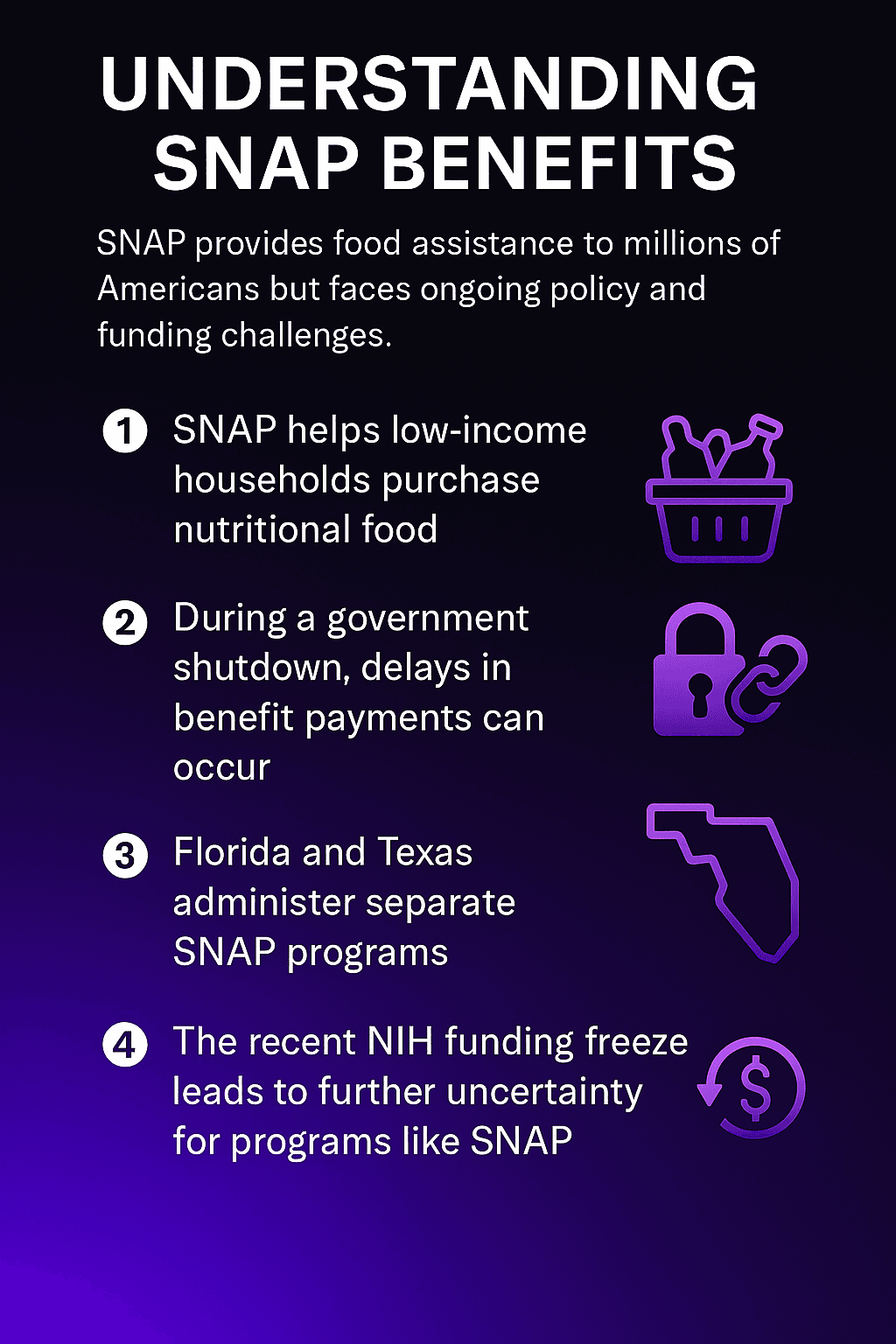
In 2025, government programs across the United States are navigating a complex environment marked by political tension, shifting priorities, and tightening budgets. Among the most discussed programs are SNAP benefits, which millions rely on for food assistance.
Recent developments, from the NIH funding freeze to questions like “is USA funding application legit” circulating online, reflect growing uncertainty about the stability and reliability of federal aid. Meanwhile, debates surrounding Trump SNAP benefits policies and their long-term impact continue to dominate headlines.
For individuals in states like Florida and Texas, the stakes are even higher, as localized SNAP administration changes and budget revisions alter access, eligibility, and payment schedules.
This article explores the structure, evolution, and current challenges of U.S. government assistance programs, with a focus on SNAP benefits, funding disruptions, and how Americans can navigate them.
Understanding SNAP Benefits: A Core Part of the U.S. Safety Net
What Is SNAP?
The Supplemental Nutrition Assistance Program (SNAP) is the nation’s largest federal food assistance initiative, designed to help low-income individuals and families afford nutritious meals. Administered by the U.S. Department of Agriculture (USDA), SNAP issues monthly electronic benefits through EBT (Electronic Benefit Transfer) cards.
As of early 2025, more than 42 million Americans rely on SNAP, a reflection of both economic inequality and the critical importance of government-backed support programs.
The Role of SNAP in Economic Stability
SNAP isn’t just about food; it’s also a stabilizing force in the U.S. economy. During recessions or crises (like the pandemic or potential government shutdowns), the program automatically expands to meet growing demand.
Economists note that every dollar in SNAP benefits generates up to $1.50 in economic activity, as recipients spend on local goods and services, including grocery stores, farmers markets, and small businesses.
However, that reliability can falter when political gridlock threatens funding, such as in discussions around the SNAP benefits government shutdown.
SNAP Benefits and the Threat of Government Shutdowns
SNAP Benefits Government Shutdown: What Happens?
When the federal government faces a shutdown due to budget impasses, funding for SNAP can be jeopardized. While the USDA often uses contingency funds to keep SNAP operational temporarily, extended shutdowns may interrupt benefit distribution.
In late 2023 and early 2024, congressional debates over federal spending led to fears that millions of households might miss their SNAP disbursements if the SNAP benefits government shutdown persisted.
Contingency Measures
In past shutdowns, the USDA pre-authorized payments for one month in advance, ensuring families weren’t immediately cut off. However, if a standoff continues, funding lapses could leave states unable to process or deliver new benefits, a serious risk for vulnerable populations.

State-Level Overview: SNAP Benefits in Florida and Texas
While SNAP is federally funded, it’s administered at the state level, which means each state can vary in its rules, application systems, and payment schedules. Two of the largest states, Florida and Texas, serve as key examples of how policy execution differs.
SNAP Benefits Florida
In Florida, the Department of Children and Families (DCF) manages SNAP distribution. As of mid-2025:
Over 3.4 million residents receive benefits monthly.
The average household benefit is about $185 per person.
Electronic applications and renewals have streamlined access, but demand remains high due to rising food prices.
Florida officials have also introduced digital tools to verify eligibility more quickly, but residents report longer wait times during federal funding disruptions.
SNAP Benefits Texas
In Texas, SNAP benefits are handled by the Health and Human Services Commission (HHSC). With over 3.8 million beneficiaries, the state is one of the largest SNAP administrators in the country.
Recent updates to SNAP benefits Texas include expanded verification processes and pilot programs allowing online grocery purchases. However, rural areas face connectivity issues, making access to digital SNAP tools challenging.
Texas has also experienced intermittent funding delays due to national budget debates, particularly during periods of fiscal uncertainty tied to potential SNAP benefits government shutdown risks.
Trump SNAP Benefits: Policy Shifts and Legacy
Policies initiated under the Trump administration reshaped much of the SNAP framework. While the program’s core mission remained intact, eligibility rules and work requirements saw significant adjustments.
Key Trump SNAP Benefits Changes
Stricter work requirements: Many able-bodied adults without dependents (ABAWDs) were required to work at least 20 hours a week to maintain benefits.
Reevaluation of waivers: States had less flexibility to waive work requirements during economic downturns.
Funding caps and reallocation proposals: Early drafts of federal budgets aimed to reduce overall SNAP spending.
While some of these measures were paused or reversed under later administrations, the Trump SNAP benefits policies established precedents for more restrictive interpretations of program eligibility.
Recent Developments: SNAP Benefits Increase and Adjustments
In 2024 and 2025, federal adjustments to the Thrifty Food Plan, the formula used to calculate benefit amounts, resulted in a SNAP benefits increase across all states.
Details of the SNAP Benefits Increase
Average nationwide boost: About 3–5% increase in monthly allotments.
Reason for the increase: Inflation adjustments, rising food costs, and a reevaluation of nutritional needs.
Impact: While the SNAP benefits increase helped offset inflation, it didn’t fully counteract rising rent, utilities, and transportation costs.
The increase reflects a broader trend of reassessing public assistance in an era of higher living costs and political volatility.
The NIH Funding Freeze and Its Ripple Effect
Though separate from SNAP, the NIH funding freeze has become emblematic of broader federal budget challenges. In early 2025, congressional disagreements led to a temporary halt in National Institutes of Health (NIH) grant disbursements.
Implications
Research delays: Thousands of scientific projects stalled, affecting universities and hospitals nationwide.
Economic spillovers: The funding freeze affected employment in research sectors and delayed innovation in health and biotech industries.
Broader message: The NIH funding freeze signals that even long-standing, bipartisan-supported programs are vulnerable in a polarized fiscal climate.
For macro investors and policy analysts, this episode serves as a warning that essential government programs, from research to nutrition assistance, can face disruption in uncertain times.
Public Confusion: Is USA Funding Application Legit?
Amid funding uncertainties, online scams have proliferated, many claiming to offer “government grants” or “relief payments” under names like “USA Funding Application.”
Clarifying the Confusion
To answer the common question: “Is USA funding application legit?”
No, the legitimate federal government does not require payment or personal data through third-party websites for funding applications.
The official channels for aid include:
grants.gov – for research or institutional grants
benefits.gov – for individual assistance like SNAP, Medicaid, or housing
state agency websites – for SNAP benefits and unemployment
Consumers should remain vigilant against fraudulent funding offers, especially during times of heightened need, such as following a stimulus check or during a SNAP benefits government shutdown scare.
How Politics and Funding Cycles Shape Program Stability
Government programs like SNAP exist within the tension between fiscal policy and social welfare. Budget ceilings, political turnover, and shifting priorities create a cycle of expansion and contraction.
Funding Freeze Implications
Events like the NIH funding freeze or a delayed federal budget can have downstream effects:
Delays in benefit disbursement
Reduced administrative staffing at state agencies
Lower confidence in government reliability
As one Washington-based policy analyst notes, “Each funding freeze chips away at public trust, it’s not just about dollars, it’s about dependability.”
Economic and Social Impact of SNAP Benefits
Studies show that SNAP not only reduces hunger but also supports broader economic resilience.
Benefits Include:
Reduced poverty rates: Especially for families with children or seniors.
Improved health outcomes: Regular access to food reduces medical costs and improves nutrition.
Local business support: SNAP spending stimulates small and mid-sized grocery chains.
Challenges:
Administrative bottlenecks during shutdowns.
Political debate over funding legitimacy and dependency concerns.
Inflation’s erosion of purchasing power despite periodic SNAP benefits increases.
Looking Ahead: The Future of U.S. Assistance Programs
As political discourse intensifies around federal budgets and social programs, questions persist about sustainability. The SNAP benefits government shutdown risk remains a real concern if Congress cannot reach timely funding agreements.
Meanwhile, agencies like the NIH face continued scrutiny over spending priorities amid competing demands for healthcare, defense, and education budgets.
In states such as Florida and Texas, the focus will remain on accessibility, ensuring residents can apply, receive, and maintain benefits efficiently even during fiscal turbulence.
Frequently Asked Questions (FAQs)
1. What happens to SNAP benefits during a government shutdown?
SNAP can operate temporarily using contingency funds, but extended shutdowns may disrupt payments if Congress fails to pass a budget.
2. What was the NIH funding freeze?
It refers to a temporary halt in NIH grant disbursements due to federal budget disputes — delaying medical research and innovation funding.
3. Are USA funding application websites legitimate?
No. Always apply for benefits through official state or federal portals like benefits.gov or your state’s SNAP website.
4. How do Trump SNAP benefits differ from today’s?
The Trump-era policies emphasized work requirements and limited waivers, whereas current rules provide more flexibility for households in need.
5. What’s the latest on SNAP benefits in Florida and Texas?
Both states continue distributing SNAP through their own systems, with slight increases reflecting national cost-of-living adjustments.
6. Will there be another SNAP benefits increase?
The USDA reviews the Thrifty Food Plan annually. Adjustments are likely if inflation remains elevated or food prices continue rising.
Conclusion: Navigating Assistance in Uncertain Times
From the NIH funding freeze to questions like “is USA funding application legit”, government programs today face an era of scrutiny and change. Yet the importance of social assistance, especially SNAP benefits, remains undeniable.
In states like Florida and Texas, millions depend on timely access to nutrition support. Nationally, policymakers continue debating eligibility, funding, and accountability. And as political and economic cycles evolve, the SNAP benefits increase represents both progress and ongoing challenge.
Ultimately, understanding these programs isn’t just a matter of policy, it’s a reflection of how America defines economic security, compassion, and the role of government itself.